A Glossary of Art Terminology
ABSTRACT
Not realistic, though the intention is often based on an actual subject, place, or feeling. Pure abstraction can be interpreted as any art in which the depiction of real objects has been entirely discarded and whose aesthetic content is expressed in a formal pattern or structure of shapes, lines and colors. When the representation of real objects is completely absent, such art may be called non-objective.
ABSTRACT EXPRESSIONISM
1940's New York painting movement based on Abstract Art. This type of painting is often referred to as action painting.
ACCENT
Emphasis given to certain elements in a painting which makes them attract more attention. Details that define an object or piece of art.
ACRYLIC
A rapid drying paint which is easy to remove with mineral spirits; a plastic substance commonly used as a binder for paints.
ACTION PAINTING
Any painting style calling for vigorous physical activity; specifically, Abstract Expressionism. Examples include the New York School art movement and the work of Jackson Pollock.
AERIAL PERSPECTIVE
Capturing the earth’s atmosphere by using painting techniques that make distant objects appear to have less color, texture, and distinction.
AESTHETIC
Pertaining to the beautiful, as opposed to the useful, scientific, or emotional. An aesthetic response is an appreciation of such beauty.
ALKYD
Synthetic resin used in paints and mediums. As a medium works as a binder that encapsulates the pigment and speeds the drying time.
ALLA PRIMA
Technique in which the final surface of a painting is completed in one sitting, without under painting. Italian for "at the first".
ANALOGOUS COLORS
Colors that are closely related, or near each other on the color spectrum. Especially those in which we can see common hues.
AQUATINT
A print produced by the same technique as an etching, except that the areas between the etched lines are covered with a powdered resin that protects the surface from the biting process of the acid bath. The granular appearance that results in the print aims at approximating the effects and gray tonalities of a watercolor drawing.
ARCHIVAL
Refers to materials that meet certain criteria for permanence such as lignin-free, pH neutral, alkaline-buffered, stable in light, etc.
ARMATURE
A rigid framework, often wood or steel, used to support a sculpture or other large work while it is being made.
ART DECO
An art style of the 1920s and 1930s based on modern materials (steel, chrome, glass). A style characterized by repetitive, geometric patterns of curves and lines.
ART NOUVEAU
An art style of the late 1800's featuring curving, often swirling shapes based on organic forms.
ARTIST'S PROOF
An Artist's Proof is one outside the regular edition. By custom, the artist retains the A/Ps for his personal use or sale.
ASSEMBLAGE
The technique of creating a sculpture by joining together individual pieces or segments, sometimes “found” objects that originally served another purpose.
ATELIER
French term for "artist’s workshop."
ATMOSPHERIC PERSPECTIVE
A device for suggesting three - dimensional depth on a two-dimensional surface. Forms meant to be perceived as distant from the viewer are blurred, indistinct, misty and often bluer.
AVANT-GARDE
A group active in the invention and application of new ideas and techniques in an original or experimental way. A group of practitioners and/or advocates of a new art form may also be called avant-garde. Some avant-garde works are intended to shock those who are accustomed to traditional, established styles.
BAROQUE
A theatrical style usually associated with European art and architecture ca. 1550-1750, characterized by much ornamentation and curved rather than straight lines; gaudily ornate.
BAS RELIEF
Sculpture in which figures project only slightly from a background, as on a coin. Also known as low relief sculpture.
BAUHAUS
A design school founded by Walter Gropius in 1919 in Germany. The Bauhaus attempted to achieve reconciliation between the aesthetics of design and the more commercial demands of industrial mass production. Artists include Klee, Kandinsky, and Feininger.
BEAUX-ARTS
A school of fine arts located in Paris, which stressed the necessity of academic painting.
BINDER
A substance in paints that causes particles of pigment to adhere to one another and to a
support such as oil or acrylic.
BRONZE
An alloy of copper and tin, sometimes containing small proportions of other elements such as zinc or phosphorus. It is stronger, harder, and more durable than brass, and has been used most extensively since antiquity for cast sculpture. Bronze alloys vary in color from a silvery hue to a rich, coppery red. U.S. standard bronze is composed of 90% copper, 7% tin, and 3% zinc.
BRUSHWORK
The characteristic way each artist brushes paint onto a support.
BURNISHING
The act of rubbing greenware (clay) with any smooth tool to polish it, and tighten the surface.
CALLIGRAPHY
In printing and drawing a free and rhythmic use of line to accentuate design. It is seen at its best in Japanese wood-block prints and Chinese scrolls. Also, fine, stylized handwriting using quills, brushes or pens with ink.
CANVAS
Closely woven cloth used as a support for paintings.
CARTOON
1. A simple drawing with humorous or satirical content.
2. A preliminary drawing for any large work such as a mural or tapestry.
CASTING
The process of making a sculpture or other object by pouring liquid material such as clay, metal or plastic into a mold and allowing it to harden, thereby taking on the shape of the confining mold.
CERAMICS
The art of making objects of clay and firing them in a kiln. Wares of earthenware and porcelain, as well as sculpture are made by ceramists. Enamel is also a ceramic technique. Ceramic materials may be decorated with slip, engobe, or glaze, applied by any number of techniques. Sculpture usually made by coil, slab, or other manual technique.
CHIAROSCURO
In drawing, painting, and the graphic arts, chiaroscuro (ke-ära-skooro) refers to the rendering of forms through a balanced contrast between light and dark areas. The technique that was introduced during the Renaissance, is effective in creating an illusion of depth and space around the principal figures in a composition. Leonardo Da Vinci and Rembrandt were painters who excelled in the use of this technique.
CLASSICAL STYLE
In Greek art, the style of the 5th century B.C. Loosely, the term “classical” is often applied to all the art of ancient Greece and Rome, as well as to any art based on logical, rational principles and deliberate composition.
COILING
A method of forming pottery or sculpture from rolls of clay that are smoothed together to form the sides of a jar or pot.
COLLAGE
A work of art made by pasting various materials such as bits of paper, cloth, etc. onto a piece of paper, board or canvas.
COLOR FIELD PAINTING
A style of painting prominent from the 1950s through the 1970s, featuring large “fields” or areas of color, meant to evoke an aesthetic or emotional response through the color alone.
COLOR WHEEL
A circular grid that represents the colors based on color theory. This grid clearly shows the relationships colors have with each other (complimentary, opposite, etc.).
COMPLIMENTARY COLORS
Hues directly opposite one another on the color wheel and therefore assumed to be as different from one another as possible. When placed side by side, complementary colors are intensified; when mixed together, they produce a neutral (or gray) color.
COMPOSITION
The organization, design or placement of the individual elements in a work of art. The aim is to achieve balance and proportionality. Usually applied to two-dimensional art.
CONCEPTUAL ART
An art form in which the underlying idea or concept and the process by which it is achieved are more important than any tangible product.
CONSTRUCTION
An art work that is actually assembled or built on the premises where it is to be shown. Many constructions are meant to be temporary and are disassembled after the exhibition is over.
CONTE
Initially it was a trade name for a brand of French crayons made from a unique compound of pigments with a chalk binder. Conte crayons are free from grease, making them acceptable for lithographic drawing.
CONTEMPORARY ART
Generally defined as art that has been produced since the second half of the twentieth century.
CONTENT
The message conveyed by a work of art - its subject matter and whatever the artist hopes to convey by that subject matter.
CONTOUR
A line that creates a boundary separating an area of space or object from the space around it.
CONTRAPPOSTO
Literally, “counterpoise.” A method of portraying the human figure, especially in sculpture, often achieved by placing the weight on one foot and turning the shoulder so the figure appears relaxed and mobile. The result is often a graceful S-curve.
CONVERGING
Lines that go towards the same point.
COOL COLORS
Those that suggest a sense of coolness. Blue , Green , Violet
CRAFTSMANSHIP
Aptitude, skill, and manual dexterity in the use of tools and materials.
CROSS-HATCHING
An area of closely spaced lines intersecting one another, used to create a sense of three-dimensionality on a flat surface, especially in drawing and printmaking. See also hatching, stippling.
CUBISM
A style of art pioneered in the early 20th century by Pablo Picasso and Georges Braque. In the most developed form of Cubism, forms are fragmented into planes or geometric facets, like the facets in a diamond; these planes are rearranged to foster a pictorial, but not naturalistic, reality; forms may be viewed simultaneously from several vantage points; figure and background have equal importance; and the colors are deliberately restricted to a range of neutrals.
CURVILINEAR
Stressing the use of curved lines as opposed to rectilinear which stresses straight lines.
DADA
A movement that emerged during World War I in Europe that purported to be anti-everything, even anti-art. Dada poked fun at all the established traditions and tastes in art with works that were deliberately shocking, vulgar, and nonsensical.
DECOUPAGE
The act of cutting out paper designs and applying them to a surface to make an all over collage.
DESIGN
The planned organization of lines, shapes, masses, colors, textures, and space in a work of art. In two-dimensional art, often called composition.
DISTORTION
Any change made by an artist in the size, position, or general character of forms based on visual perception, when those forms are organized into a pictorial image. Any personal or subjective interpretation of natural forms must necessarily involve a degree of distortion.
DOMINANCE
The principle of visual organization which suggests that certain elements should assume more importance than others in the same composition. It contributes to the organic unity by emphasizing the fact that there is one main feature and that other elements are subordinate to it.
DRYPOINT
An intaglio printmaking technique, similar to engraving, in which a sharp needle is used to draw on a metal plate, raising a thin ridge of metal that creates a soft line when the plate is printed. Also, the resultant print.
DYNAMIC
Giving an effect of movement, vitality, or energy.
EARTHENWARE
Ceramic ware, usually coarse and reddish in color, fired in the lowest temperature ranges. Used for domestic ware, glazed or unglazed.
EDITION
In bronze sculpture and printmaking, the number of pieces/images made from a single mold/plate and authorized by the artist.
ENCAUSTIC
Literally, to burn in. A painting technique in which the pigment is mixed with melted wax and resin and then applied to a surface while hot.
ENGRAVING
Printmaking method in which a sharp tool (burin) is used to scratch lines into a hard surface such as metal or wood.
ENVIRONMENTAL ART
1. Art that is large enough for viewers to enter and move about in.
2. Art designed for display in the outdoor environment.
3. Art that actually transforms the natural landscape.
ETCHING
The technique of reproducing a design by coating a metal plate with wax and drawing with a sharp instrument called a stylus through the wax down to the metal. The plate is put in an acid bath, which eats away the incised lines; it is then heated to dissolve the wax and finally inked and printed on paper. The resulting print is called the etching.
EXPRESSIONISM
Any art that stresses the artist’s emotional and psychological reaction to subject matter, often with bold colors and distortions of form. Specifically, an art style of the early 20th century followed principally by certain German artists.
FAUVISM
A short lived painting style in early 20th century France, which featured bold, clashing, arbitrary colors - colors unrelated to the appearance of forms in the natural world. Henri Matisse was its best-known practitioner. The word fauve means “wild beast.”
FIGURE - GROUND
In two-dimensional art, the relationship between the principal forms and the background. Figure-ground ambiguity suggests equal importance for the two.
FINE ART
An art form created primarily as an aesthetic expression to be enjoyed for its own sake. The viewer must be prepared to search for the intent of the artist as the all-important first step toward communication and active participation.
FIRING
Heating pottery or sculpture in a kiln or open fire to bring the clay to maturity. The temperature needed to mature the clay varies with the type of body used. Also, heating glazed ware to the necessary point to cause the glaze to mature.
FIXATIVE
A solution, usually of shellac and alcohol, sprayed onto drawings, to prevent their smudging or crumbling off the support.
FOLK ART
Primitive art, by an untrained artist who paints in the common tradition of his community and reflects the life style of the people. Also called ‘Outsider art’ & ‘Art brut’.
FORESHORTENING
A method of portraying forms on a two-dimensional surface so that they appear to project or recede from the picture plane.
FORGING
Shaping metal with hammers while it is hot; the method for making wrought iron.
FORM
1. The physical appearance of a work of art - its materials, style, and composition.
2. Any identifiable shape or mass, as a “geometric form.”
FRESCO
A painting technique in which the pigments are dispersed in plain water and applied to a damp plaster wall. The wall becomes the binder, as well as the support.
FUTURISM
Art movement founded in Italy in 1909 and lasting only a few years. Futurism concentrated on the dynamic quality of modern technological life, emphasizing speed and movement.
GENRE
Art that depicts the casual moments of everyday life and its surroundings.
GEOMETRIC SHAPES
Shapes created by exact mathematical law.
GESSO
A white ground material for preparing rigid supports for painting. made of a mixture of chalk, white pigment, and glue. Same name applied to acrylic bound chalk and pigment used on flexible supports as well as rigid.
GLAZE
A very thin, transparent colored paint applied over a previously painted surface to alter the appearance and color of the surface. In ceramics, washes applied to the clay body which, when fired to temperature, vitrify to form a thin, usually colored, glass layer.
GOTHIC
A style of architecture and art dominant in Europe from the 12th to the 15th century. Gothic architecture features pointed arches, ribbed vaults, and often large areas of stained glass.
GOUACHE
Opaque watercolors used for illustrations.
GROUND
1. A substance applied to a painting or drawing support in preparation for the pigmented material.
2. The preparatory substance used as a coating for a printmaking plate.
3. The background in a work of two-dimensional art.
GREENWARE
Unfired pottery or sculpture.
HARD-EDGE PAINTING
A recent innovation that originated in New York and was adopted by certain contemporary painters. Forms are depicted with precise, geometric lines and edges.
HARMONY
The unity of all the visual elements of a composition achieved by repetition of the same characteristics.
HATCHING
A technique of modeling, indicating tone and suggesting light and shade in drawing or tempera painting, using closely set parallel lines.
HORS COMMERCE
(‘Before commerce’) traditionally were the sculpture/graphics pulled with the regular edition, but were marked by the artist for business use only. These pieces were used for entering exhibitions and competitions, but today, these they generally are allowed into distribution through regular channels.
HUE
The perceived color of an object, identified by a common name such as red, orange, blue.
ICONOGRAPHY
Loosely, the “story” depicted in a work of art; people, places, events, and other images in a work, as well as the symbolism and conventions attached to those images by a particular religion or culture.
ILLUMINATION
Hand-drawn decoration or illustration in a manuscript, especially prevalent in medieval art.
IMPASTO
A thick, juicy application of paint to canvas or other support; emphasizes texture, as distinguished from a smooth flat surface.
IMPRESSIONISM
A painting technique in which the artist concentrates on the changing effects of light and color. Often this style can be characterized by its use of discontinuous brush strokes and heavy impasto.
INLAY
In woodworking, a technique in which small pieces of wood, often with varying grains and colours, are glued together to make a pattern.
INTENSITY
The degree of purity or brilliance of a color. Also known as chroma or saturation.
KINETIC ART
Kinetic art is art that incorporates movement as part of its expression – either mechanically, by hand, or by natural forces.
KILN
A furnace or oven built of heat-resistant materials for firing pottery, glass and sculpture.
LANDSCAPE
A generalization for any artist’s depiction of natural scenery. Figures and other objects should be of secondary importance to the composition and incidental to the content.
LINE
A mark made by an instrument as it is drawn across a surface.
LINEAR PERSPECTIVE
A method of depicting three-dimensional depth on a flat or two-dimensional surface. Linear perspective has two main precepts: 1. Forms that are meant to be perceived as far away from the viewer are made smaller than those meant to be seen as close 2. Parallel lines receding into the distance converge at a point on the horizon line known as the vanishing point.
LITHOGRAPHY - LITHOGRAPH
A printing process in which a surface, as stone or sheet aluminum, is treated so that the ink adheres only to the portions that are to be printed. The resulting image is a lithograph or a lithographic print
LOST WAX
A method of creating a wax mold of a sculpture and then heating the mold to melt out the wax and replacing it with a molten metal or resin. (see our page on Bronze Casting).
MANIFESTO
In art, a public declaration or exposition in print of the theories and directions of a movement. The manifestos issued by various individual artists or groups of artists, in the first half of the twentieth century served to reveal their motivations and raisons dâetre and stimulated support for or reactions against them.
MANNERISM
A term sometimes applied to art of late 16th early 17th century Europe, characterized by a dramatic use of space and light and a tendency toward elongated figures.
MAQUETTE
In sculpture, a small model in wax or clay, made as a preliminary sketch, presented to the client for approval of the proposed work, or for entry in a competition. The Italian equivalent of the term is bozzetto, meaning small sketch.
MASS
Three-dimensional form, often implying bulk, density and weight.
MATTE
Flat, non-glossy; having a dull surface appearance.
MEDIEVAL ART
The art of the Middle Ages ca. 500 A.D. through the 14th century. The art produced immediately prior to the Renaissance.
MEDIUM
1. The material used to create a work of art. 2. The binder for a paint, such as oil. 3. An expressive art form, such as painting, drawing, or sculpture.
MINIMALISM
A style of painting and sculpture in the mid 20th century in which the art elements are rendered with a minimum of lines, shapes, and sometimes color. The works may look and feel sparse, spare, restricted or empty.
MIXED MEDIA
Descriptive of art that employs more than one medium – e.g., a work that combines paint, natural materials (wood, pebbles, bones), and man made items (glass, plastic, metals) into a single image or piece of art.
MOBILE/STABILE
Terms coined to describe work created by Alexander Calder. The mobile is a hanging, movable sculpture and the stabile rests on the ground but also may have moving parts.
MODELLING
1. In sculpture, shaping a form in some plastic material, such as clay, wax, or plaster. 2. In drawing, painting, or printmaking, the illusion of three-dimensionality on a flat surface created by simulating effects of light and shadow.
MONOCHROMATIC
Having only one color. Descriptive of work in which one hue - perhaps with variations of value and intensity - predominates.
MONOTYPE
A one-of-a-kind print made by painting on a sheet or slab of glass and transferring the still-wet painting to a sheet of paper held firmly on the glass by rubbing the back of the paper with a smooth implement, such as a large hardwood spoon. The painting may also be done on a polished plate, in which case it may be either printed by hand or transferred to the paper by running the plate and paper through an etching press.
MONTAGE
A picture composed of other existing illustrations, pictures, photographs, newspaper clippings, etc. that are arranged so they combine to create a new or original image. A collage.
MOSAIC
An art form in which small pieces of tile, glass, or stone are fitted together and embedded into a background to create a pattern or image.
MURAL
Any large-scale wall decoration done in painting, fresco, mosaic, or other medium.
MUSEUM
A building, place or institution devoted to the acquisition, conservation, study, exhibition and educational interpretation of objects having scientific, historical or artistic value. The word Museum is derived from the Latin muses, meaning "a source of inspiration," or "to be absorbed in one's thoughts."
NARRATIVE PAINTING
A painting where a story line serves as a dominant feature.
NATURALISTIC
Descriptive of an artwork that closely resembles forms in the natural world. Synonymous with representational.
NEGATIVE SPACE
The space in a painting around the objects depicted.
NEOCLASSICISM
- “New” classicism - a style in 19th century Western art that referred back to the classical styles of Greece and Rome. Neoclassical paintings have sharp outlines, reserved emotions, deliberate (often mathematical) composition, and cool colors.
NEO-EXPRESSIONISM
- “New” expressionism - a term originally applied to works done primarily by German and Italian, who came to maturity in the post-WWII era; and later expanded (in the 1980’s) to include certain American artists. Neo- Expressionist works depict intense emotions and symbolism, sometimes using unconventional media and intense colors with turbulent compositions and subject matter.
NEUTRAL
Having no hue - black, white, or gray; sometimes a tannish color achieved by mixing two complementary colours.
NON-OBJECTIVE
Completely non-representational; pure design; fully abstract.
OP ART
Short for Optical Art, a style popular in the 1960s that was based on optical principles and optical illusion. Op Art deals in complex color interactions, to the point where colors and lines seem to vibrate before the eyes
OPTICAL COLOR MIXTURE
The tendency of the eyes to blend patches of individual colors placed near one another so as to perceive a different, combined color. Also, any art style that exploits this tendency, especially the pointillism of Georges Seurat.
ORGANIC
An image that shows a relationship to nature as opposed to man-made images. Any shape that resembles a naturally occurring form or that suggests a natural growing or expanding process.
ORGANIC ART
An art form that emphasizes an object alive in its own right and not contrived.
OVERLAP EFFECT
Spatial relationships are achieved by placing one object in front of another. The object closest to the viewer blocks out the view of any part of any other object located behind it (or, where the two objects overlap, the one in back is obscured).
PAINTERLY
Descriptive of paintings in which forms are defined principally by color areas, not by lines or edges. Where the artist's brushstrokes are noticeable. Any image that looks as though it may have been created with the style or techniques used by a painter.
PASTEL
A colored crayon that consists of pigment mixed with just enough of a aqueous binder to hold it together; a work of art produced by pastel crayons; the technique itself. Pastels vary according to the volume of chalk contained...the deepest in tone are pure pigment. Pastel is the simplest and purest method of painting, since pure color is used without a fluid medium and the crayons are applied directly to the pastel paper.
PATINA
A film or an incrustation, often green, that forms on copper and bronze after a certain period of weathering and as a result of the oxidation of the copper. Different chemical treatments will also induce myriad colored patinas on new Bronze works. Bronzes may additionally be painted with acrylic and lacquer.
PENTIMENTO
A condition of old paintings where lead-containing pigments have become more transparent over time, revealing earlier layers.

Marina Abramovic performance art
PERFORMANCE ART
Art in which there is no concrete object, but rather a series of events performed by the artist in front of an audience, possibly including music, sight gags, recitation, audio-visual presentations, or other elements.
PERSPECTIVE
The representation of three-dimensional objects on a flat surface so as to produce the same impression of distance and relative size as that received by the human eye. In one-point linear perspective, developed during the fifteenth century, all parallel lines in a given visual field converge at a single vanishing point on the horizon. In aerial or atmospheric perspective, the relative distance of objects is indicated by gradations of tone and color and by variations in the clarity of outlines.
PHOTO REALISM
A painting and drawing style of the mid 20th century in which people, objects, and scenes are depicted with such naturalism that the paintings resemble photographs – an almost exact visual duplication of the subject.
PICTORIAL SPACE
The illusory space in a painting or other work of two-dimensional art that seems to recede backward into depth from the picture plane, giving the illusion of distance.
PICTURE PLANE
An imaginary flat surface that is assumed to be identical to the surface of a painting. Forms in a painting meant to be perceived in deep three-dimensional space are said to be “behind” the picture plane. The picture plane is commonly associated with the foreground of a painting.
PIGMENT
A coloring substance made from plants, earth, or minerals and may include other synthetic elements. When mixed with binders it becomes paint, ink or crayon, etc.
POINTILLISM
A branch of French Impressionism in which the principle of optical mixture or broken color was carried to the extreme of applying color in tiny dots or small, isolated strokes. Forms are visible in a pointillist painting only from a distance, when the viewer's eye blends the colors to create visual masses and outlines. The inventor and chief exponent of pointillism was George Seurat (1859-1891); the other leading figure was Paul Signac (1863-1935).
POLYCHROMATIC
Having many colors, as opposed to monochromatic which means only one hue or color.
POP ART
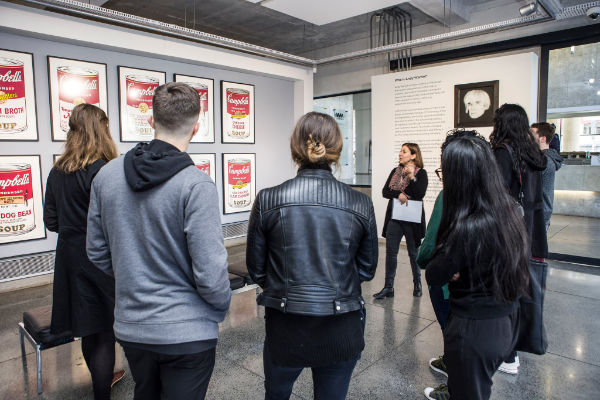
A style derived from commercial art forms and characterized by larger than life replicas of items from mass culture. This style evolved in the late 1950s and was characterized in the 1960s by such artists as Jasper Johns, Andy Warhol, Claus Oldenberg, Roy Lichtenstein, Larry Rivers, Robert Rauschenberg, George Segal, and Robert Indiana.
PORCELAIN
A ceramic ware fired to the highest temperature ranges and often used for dinnerware, vases, and smaller sculpture.
POSITIVE SPACE
The space in a painting occupied by the object depicted (not the spaces in-between objects)
POST IMPRESSIONISM
A term applied to the work of several artists - French or living in France - from about 1885 to 1900. Although they all painted in highly personal styles, the Post-Impressionists were united in rejecting the relative absence of form characteristic of Impressionism and stressed more formal qualities and the significance of subject matter.
PREHISTORIC ART
Art forms predating recorded history, such as Old, Middle, and New Stone Ages.
PRE-COLUMBIAN
Art created in the America's by native people that pre-dates the discovery of the new world
PRIMARY COLORS
Any hue that, in theory, cannot be created by a mixture of any other hues. Varying combinations of the primary hues can be used to create all the other hues of the spectrum. In pigment the primaries are red, yellow, and blue.
An image created from a master wood block, stone, plate, or screen, usually on paper. Prints are referred to as multiples, because as a rule many identical or similar impressions are made from the same printing surface, the number of impressions being called an edition. When an edition is limited to a specified number of prints, it is a limited edition. A print is considered an original work of art and today is customarily signed and numbered by the artist.
PRIMITIVE ART
1. Paintings and drawings of and by peoples and races outside the influence of accepted Western styles.
2. Religious portrayals predating scientific studies of perspective and anatomy.
3. Intuitive artists with a "naive" style often due to little, if any, training (or works intentionally made to
look this way).
PROPORTION
Size relationships between parts of a whole, or between two or more objects perceived as a unit.
REALISM
Any art in which the goal is to portray forms in the natural world in a highly representational manner. Specifically, an art style of the mid 19th century, which fostered the idea that everyday people and events are worthy subjects for important art.
RELATIVE APPARENT SIZE
Objects appear smaller as their distance from the viewer increases.
RELATIVE POSITION
We view nature from our own eye level. Objects in the foreground appear lower and distant objects appear higher relative to the imaginary line created by our level of sight.
RELIEF
1. Sculpture in which figures or other images are attached to a flat background but project out from it to some degree (bas-relief, haut-relief). 2. A printmaking technique in which portions of a block meant to be printed are raised above the surface.
RENAISSANCE
Literally, “rebirth”. The period in Europe from the 14th to the 16th century, characterized by a renewed interest in Classical art, architecture, literature, and philosophy. The Renaissance began in Italy and gradually spread to the rest of Europe. In art, it is most closely associated with Leonardo da Vinci, Michelangelo, and Raphael.
REPRESENTATIONAL
Works of art that closely resemble forms in the natural world. Synonymous with naturalistic
ROCOCO
A style of art popular in Europe in the first three quarters of the 18th century, Rococo architecture and furnishings emphasized ornate but small-scale decoration, curvilinear forms, and pastel colors. Rococo painting has a playful, light-hearted romantic quality and often pictures the aristocracy at leisure.
ROMANESQUE
A style of architecture and art dominant in Europe from the 9th to the 12th century. Romanesque architecture, based on ancient Roman precedents, emphasizes the round arch and barrel vault.
ROMANTICISM
A movement in Western art of the 19th century generally assumed to be in opposition to Neoclassicism. Romantic works are marked by intense colors, turbulent emotions, complex composition, soft outlines, and sometimes heroic subject matter.
SALON
1. Fashionable gathering of artists, writers, and intellectuals held in a private home.
2. In France, a state-sponsored exhibition of art, held in Paris, controlled by the
Academy of Fine Arts.
SCALE
Size in relation to some “normal” or constant size. Compare with proportion.
SCULPTURE
A three-dimensional form modeled, carved, or assembled.
SECONDARY COLORS
A hue created by combining two primary colours, as yellow and blue mixed together yield green. In pigment the secondary colors are orange, green, and violet.
SERIGRAPH
Serigraphy is a color stencil printing process in which a special paint is forced through a fine screen onto the paper beneath. Areas that do not print are blocked with photo sensitive emulsion that has been exposed with high intensity arc lights. A squeegee is pulled from back to front, producing a direct transfer of the image from screen to paper. A separate stencil is required for each color and one hundred colors or more may be necessary to achieve the desired effect. A serigraph, also referred to as a screen print, differs from other graphics in that its color is made up of paint films rather than printing ink stains. This technique is extremely versatile, and can create effects similar to oil color and transparent washes, as well as gouache and pastel.
SFUMATO
From the Italian work for “smoke,” a technique of painting in thin glazes to achieve a hazy, cloudy atmosphere, often to represent objects or landscape meant to be perceived as distant from the picture plane.
SHAPE
A two-dimensional area having identifiable boundaries, created by lines, color, or value changes, or some combination of these; broadly, form.
SIMULTANEOUS CONTRAST
The tendency of complementary colors to seem brighter and more intense when placed side by side.
SILHOUETTE
The outer shape of an object. An outline, often filled in with color.
SKETCH
A preliminary drawing of a composition.
SPACE
In painting, space may by defined as the distances between shapes on a flat surface and the illusion of three-dimensions on a two-dimensional surface. Also refers to a physical site where art is displayed for viewing.
STILL LIFE
A painting or other two-dimensional work in which the subject matter is an arrangement of objects - fruit, flowers, tableware, pottery, and so forth - brought together for their pleasing contrasts of shape, color, and texture, Also the arrangement of the objects itself.
STIPPLING
A pattern of closely spaced dots or small marks used to create a sense of three-dimensionally on a flat surface, especially in drawing and printmaking. See also hatching, cross-hatching.
STUDY
A detailed drawing or painting made of one or more parts of a final composition, but not the whole work.
STYLE
A characteristic, or a number of characteristics that we can identify as constant, recurring, or coherent. In art, the sum of such characteristics associated with a particular artist, group, or culture, or with an artist’s work at a specific time.
STYLIZED
Descriptive of works based on forms in the natural world, but simplified or distorted for design purposes. See also abstract.
SUPPORT
The surface on which a work of two-dimensional art is made i.e.: canvas, paper, cardboard, or wood.
SURREALISM
A painting style of the early 20th century that emphasized imagery and visions from dreams and fantasies, as well as an intuitive, spontaneous method of recording such imagery, often combining unrelated or unexpected objects in compositions .
SYMBOL
An image or sign that represents something else, because of convention, association, or resemblance.
SYMMETRICAL
Descriptive of a design in which the two halves of a composition on either side of an imaginary central vertical axis correspond to one another in size, shape, and placement.
TACTILE
A quality which refers to the sense of touch.
TAPESTRY
A type of weaving in which the crosswise yarns are manipulated freely to create patterned or pictorial effects.
TEMPERA
A painting medium in which the binder is egg yolk.
TERTIARY COLORS
Six colors positioned between the primary and secondary colors on the color wheel.
TEXTURE
The actual feel (roughness or smoothness) of a surface. In art, texture may refer to the illusion of roughness or smoothness often achieved with contrasting patterns.
TRIPTYCH
A three-part work of art; especially a painting, meant for placement on an altar, with three panels that fold together.
TONALITY
The overall color effect in terms of hue and value. Often one dominating hue is employed in various shades and values.
TROMPE-L’OEIL
A French term meaning "deception of the eye." A painting or other work of two-dimensional art rendered in such a photographically realistic manner as to ‘trick’ the viewer into thinking it is three-dimensional reality.
UNDERPAINTING
The traditional stage in oil painting of using a monochrome or dead color as a base for composition. Also known as laying in.
VALUE
The relative lightness or darkness of a hue, or of a neutral varying from white to black.
VANISHING POINT
In linear perspective, the point on the horizon line where parallel lines appear to converge.
VEHICLE
The entire liquid contents of a paint.
VERTICAL
A line from top to bottom or bottom to top. upright.
VOLUME
Similar to mass, a three-dimensional form implying bulk, density, and weight; but also a void or empty, enclosed space.
WARM COLORS
Those which suggest a sense of warmth i.e.: red, yellow and orange.
WASH
Used in watercolor painting, brush drawing, and occasionally in oil painting and sculpture to describe a broad thin layer of diluted pigment, ink, glaze or patina. Also refers to a drawing made in this technique.
WATERCOLOR
A painting medium in which the binder is gum arabic. Water is used to thinning, lightening or mixing.
YELLOWING
This effect on oil paintings is usually caused by one of three reasons: excessive use of linseed oil medium; applying any of the varnishes that are prone to yellow with age; or most often – an accumulation of dirt embedded into the varnish.
